
When you are searching for a new workspace, the focus usually falls on rent, location, size and amenities. However, one clause that often has a long-term impact but gets overlooked is the lock-in period.
Whether you are signing your first office lease or upgrading to a larger space, understanding what is lock in period in rent agreement can save you from unexpected financial and operational stress later.
Let us break it down in simple terms and see why it matters so much, especially in today’s flexible work environment.
What Is a Lock-in Period in Rent Agreement?
A lock-in period is a minimum time duration during which both the tenant and the landlord are bound to the rental agreement and cannot exit it without facing penalties.
In other words, once the agreement is signed, neither party can legally terminate the contract before this period ends, unless specific exit conditions are mentioned.
For example, if an office rental agreement has a lock-in period of three years, both you and the property owner are expected to honour the lease for those three years, regardless of business changes or shifting needs.
This clause is especially common in commercial office rental agreements where property owners want assurance of stable occupancy and tenants seek predictability in costs.
Why Do Lock-in Periods Exist in Office Rental Agreements?
Lock-in periods exist primarily to protect both parties involved.
From the landlord’s perspective, commercial spaces often require investments in interiors, brokerage fees and maintenance. A lock-in ensures that the tenant stays long enough for these costs to be recovered.
From the tenant’s perspective, a lock-in period can help secure a lower rent, stable terms and priority over the space without worrying about sudden eviction.
In a well-structured office rental agreement, the lock-in period brings balance and stability, provided it aligns with your business needs.
How Long Is a Typical Lock-in Period?
There is no fixed duration that applies to every agreement, but common lock-in periods for office spaces in India are:
- 12 to 36 months for small and mid-sized offices
- 3 to 5 years for large commercial office rental agreements
- Shorter or zero lock-in periods for flexible or managed office spaces
The length usually depends on the type of property, location, fit-out costs and the negotiation between both parties.
What Happens If You Exit Before the Lock-in Period Ends?
This is where many businesses face challenges.
If you break the agreement before the lock-in period expires, you may be required to:
- Pay rent for the remaining lock-in duration
- Forfeit your security deposit
- Or compensate the landlord as per the exit clause
The exact penalty depends on how your office rental agreement is drafted, so it is critical to read this section carefully before signing.
Lock-in Period vs Notice Period: What Is the Difference?
These two terms are often confused, but they are not the same.
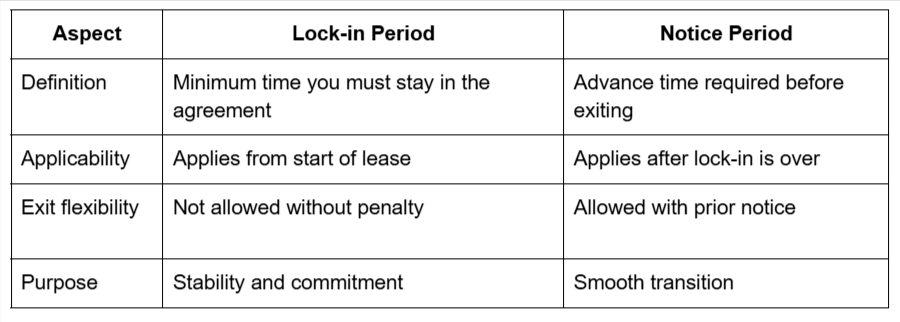
In simple terms, you cannot use a notice period to exit during the lock-in period unless your agreement specifically allows it.
Why Businesses Should Pay Special Attention to Lock-in Periods Today
With hybrid work, expansion uncertainties and evolving team sizes, committing to a long lock-in period can sometimes limit operational flexibility.
Businesses today are increasingly cautious about:
- Overcommitting to long-term fixed leases
- Paying penalties due to downsizing or relocation
- Getting locked into underutilised spaces
This is why many companies now explore flexible models like managed offices or co-working where lock-in periods are minimal or negotiable.
How to Negotiate a Lock-in Period Smartly
Lock-in periods are not always rigid. With the right approach, you can negotiate terms that protect your business.
Here are a few practical tips:
- Ask for a shorter lock-in period or a soft lock-in clause
- Negotiate a mutual exit option after a defined period
- Include a break clause in case of business restructuring
- Clarify penalty structure instead of leaving it vague
- Align lock-in duration with your business visibility and growth plans
A well-negotiated office rental agreement should support your business, not restrict it.
When Does a Lock-in Period Make Sense?
Despite the risks, lock-in periods are not always bad.
They can be beneficial when:
- You are confident about long-term operations in one location
- You are getting a significantly better rental rate
- The landlord is investing heavily in fit-outs
- You want stability in a premium commercial office rental property
The key is ensuring that the commitment matches your business certainty.
How Flexible Office Spaces Change the Lock-in Equation
In recent years, businesses have started favouring workspaces that offer more adaptability.
If you are looking for office space for rent without long-term constraints, flexible and managed office spaces offer:
- Shorter or zero lock-in periods
- Easier exit options
- Built-in services without capital investment
- Scalability without lease renegotiation
This model reduces the traditional risks associated with long lock-in periods and aligns better with modern business dynamics.
Also Read- Why Flexible Seating Improves Collaboration and Creativity?
Final Thoughts
Understanding what is locked in a period in a rent agreement is not just about legal clarity. It is about protecting your business from decisions that might feel right today but become limiting tomorrow.
Before signing any office rental agreement, take the time to evaluate:
- How long you realistically see your business operating from that space
- Whether the lock-in period supports your growth plans
- And how flexible your exit options are
The right workspace is not only about where you work, but also about how freely you can evolve. Making informed choices around lock-in periods ensures that your office supports your business journey rather than restricting it.


