Registering a small business at a home address used to raise a few eyebrows. That changed after GST officers began checking. Between April 2023 and October 2025, the government identified over 10,000 fake GST registrations, according to figures shared in Parliament. Many listed addresses where no business existed.
So where does that leave a founder who works from home, or a consultant with clients in three states? Usually with a virtual office service. What is a virtual office, though, and does it hold up when an officer visits? This guide covers how it works, how to set one up, and where it fits for GST and company registration in India.
Virtual Offices in India: Some Context
India’s flexible office stock crossed 110 million sq ft in 2025, about three times its 2020 size, according to CBRE and FICCI. Cushman & Wakefield puts flex at roughly a fifth of office leasing in the top cities and expects the stock to reach about 160 million sq ft by 2030.
Compliance has tightened alongside that growth. The government reported 5,699 fake GST registrations in 2023–24 and 3,977 in 2024–25. Under the amended Rule 8 of the CGST Rules, applicants flagged by risk checks now go through biometric Aadhaar authentication, and officers can inspect the declared place of business.
An address now has to survive a visit, not just a form.
What Is a Virtual Office?
A virtual office lets a business use a commercial address without renting the space behind it. The fee covers the address and the support around it, not square footage.
A typical virtual office service in India includes a business address in a commercial building, a No Objection Certificate (NOC) from the owner, an agreement and a utility bill for registrations, mail handling, and a reception desk. Meeting rooms or a desk for the day are usually available on top.
What Is a Virtual Office Address?
People often ask what is a virtual office address and how it differs from any other address. The answer is consent. The owner has formally allowed the business to use it, and the business can be traced there. With the right documents, it can serve as a GST place of business or a company’s registered office. A friend’s flat cannot offer that.
Physical and Digital Virtual Offices
A digital virtual office moves the paperwork online. KYC, agreements and payments happen digitally, and incoming mail is scanned and emailed. It’s convenient, but there’s a catch: the address behind it still has to be a real, staffed centre. GST officers inspect premises, not apps.
How Does a Virtual Office Work?
The provider holds the premises and the owner’s consent. It issues the documents, receives post and visitors, and keeps the business on record. The team works wherever it likes. When a client meeting comes up, it books a room at the same centre, so the address on the invoice and the venue match.
How to Set Up a Virtual Office
Setting one up takes days rather than weeks. Here is how to set up a virtual office in five steps.
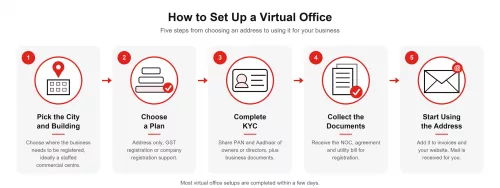
1. Pick the City and Building
Start with where the business needs to be registered. That could be the state it bills from, a new market, or simply a business district that reads well on a proposal. An established commercial centre holds up far better at verification than a residential-looking block.
2. Choose a Plan
Virtual office services usually come in three tiers: address only, GST registration, and company registration. If you’re likely to need GST within the year, start with that tier. Upgrading later can mean redoing paperwork.
3. Complete KYC
Expect to share PAN and Aadhaar for the proprietor, partners, or directors, plus the business PAN and incorporation papers if the entity exists. Good operators take this seriously. Every business registered at a centre affects how officials view that building.
4. Collect the Documents
After KYC, the provider issues the NOC, the agreement, and a recent utility bill. These go into the GST application, the incorporation filing, or a bank account opening.
5. Start Using the Address
Put it on invoices, the website, and the Google Business Profile. Mail arrives at the centre, and the business is told. That’s the whole system.
Benefits of a Virtual Office
The obvious benefit is cost. There’s no deposit, fit-out, furniture, or electricity bill to fund. The other benefits of a virtual office matter just as much.
A commercial address earns trust from clients and investors. Founders keep their home address off public listings. A business can show up in a new city within a week, without signing a lease. And when the team needs a room, the day passes, and meeting rooms sit in the same building.
None of this works if the address is flimsy. The benefits of a virtual office depend on it passing verification.
Using a Virtual Office for GST Registration
GST is why most Indian businesses take a virtual office. The law requires a principal place of business, and applicants must prove the right to use it. For rented premises, that usually means the agreement, an NOC from the owner, and an electricity bill or property tax receipt for the address. A GST-ready plan supplies all three. For the wider process, see this guide to GST registration for private limited companies.
Verification is where cheap addresses fail. Under Rule 8, an officer can visit, and practitioners say officers look for signs of real occupation, such as a nameplate. A centre with reception staff who know the business, and its name on display, passes. A bare address often doesn’t.
GST registration is also state-wise. Consultants and online sellers often use a virtual office in a second state instead of opening a branch.
Using a Virtual Office for Company Registration
Section 12 of the Companies Act, 2013 requires every company to have a registered office within 30 days of incorporation, verified through Form INC-22 if it wasn’t declared at the start. The company’s name and address must also be displayed outside the office.
A virtual office covers this with the owner’s NOC, address proof that MCA accepts, signage, and staff to receive notices. Already-incorporated companies can move their registered office to one by filing the change. This blog explains why businesses use a virtual office address as their registered office.
Virtual Office vs Coworking vs Traditional Office
| Virtual office | Coworking space | Traditional office | |
| What is paid for | Address and services | Desks or cabins | An entire leased space |
| Workspace | On demand | Daily | Daily, exclusive |
| Setup time | Days | Days | Weeks to months |
| Upfront cost | Lowest | Low | High |
| Commitment | Usually annual | Monthly onwards | Long lock-in |
Startups, freelancers, online sellers, and companies testing a new city usually begin with a virtual office. Teams that need to sit together daily, or businesses whose licences require a factory or warehouse, need more. Growing teams often move to coworking, then a private cabin or a managed office. Staying with one provider means the registered address doesn’t have to change.
Cost and Choosing a Provider
Price depends on the city, the micro-market, the plan tier, and the tenure. Most plans are billed yearly. Even the top tier costs a fraction of a lease.
Price shouldn’t decide it, though. Before signing up for a virtual office service, check that the address is a staffed centre, that the documents suit GST and MCA filings, and that the business name will be displayed. Ask how mail is handled and whether there are centres in other states. An address that fails verification costs more in delays than it ever saved.
The Bottom Line
A virtual office used to be a way to save rent. Today it’s a compliance decision, and the quality of the address is what counts.
Awfis Virtual Office plans offer an address at an operating Awfis centre, documents for GST or company registration, and access to meeting rooms, day passes, and flexible desks. Plans can be booked online or set up with help from the Awfis compliance team. Explore Awfis Virtual Office plans and pick an address where your business wants to grow.
Frequently Asked Questions
Q1. What is a virtual office?
It’s a service that gives a business a commercial address, registration documents, and mail and reception support, without renting workspace.
Q2. What is a virtual office address?
It’s a commercial address a business is formally allowed to use. With the owner’s NOC and supporting documents, it can serve for GST or as a registered office.
Q3. How to set up a virtual office in India?
Pick a city, choose a plan, complete KYC, and collect the NOC, agreement, and utility bill. Most setups take a few days.
Q4. Can a virtual office be used for GST registration?
Yes, provided the premises are genuine. Officers may visit, so a staffed centre with the business name displayed matters.
Q5. Is a digital virtual office valid?
Yes, as long as a real physical address sits behind it. The premises are what get verified.