Fitting out a 20,000 sq ft office in Bengaluru costs roughly ₹12 crore before a single employee sits down. That figure comes from Cushman & Wakefield’s 2026 fit-out guide, which puts a collaborative hybrid workplace in the city at about ₹6,027 per sq ft. Add the rent deposit, furniture and IT, and a growing company can lock up a large slice of its cash in walls and wiring.
That’s why the capex versus opex question has moved from the finance team’s spreadsheet to the boardroom. This guide explains what is capex, what is opex, the difference between capex and opex, and why so many expanding companies now take managed offices instead of building their own.
What Is CapEx?
Capital expenditure, or capex, is money spent on assets that serve the business for more than a year. It doesn’t hit the profit and loss account in one go. Instead, the asset goes on the balance sheet, and its cost is spread over its useful life through depreciation.
Indian income-tax rules show how slowly that happens. Furniture and fittings are typically depreciated at 10% a year on a written-down basis, and computers at 40%. A rupee spent on office furniture today is recovered, for tax purposes, over many years.
Types of Capital Expenditure
For an office, the main types of capital expenditure are:
- Land or building purchase
- Interior fit-out, including partitions, ceilings, flooring, lighting and electrical work
- Furniture and fixtures
- IT and network infrastructure, such as servers, cabling and security systems
- Major upgrades or renovations that extend an asset’s life
Capex is usually lumpy. It arrives in large amounts at the start of a project, then repeats when the space needs a refresh.
What Is OpEx?
Operating expenditure, or OpEx, covers the regular costs of running the business. These are expensed in the period they occur, so they reduce profit that year and leave the balance sheet alone.
Types of Operating Costs
The common types of operating costs for an office are:
- Rent or workspace fees
- Utilities such as electricity, water, and internet
- Housekeeping, security and facility management
- Repairs and routine maintenance
- Insurance, salaries, and software subscriptions
Opex is predictable. It’s paid monthly or quarterly and can usually be scaled up or down as the business changes.
The Difference Between CapEx and OpEx
The difference between CapEx and OpEx comes down to timing, accounting treatment, and flexibility.
| CapEx | OpEx | |
|---|---|---|
| What it buys | Long-term assets | Day-to-day running costs |
| Payment pattern | Large and upfront | Regular and recurring |
| Accounting | Capitalised, then depreciated | Expensed in the same period |
| Effect on cash | Ties up cash early | Spreads cost over time |
| Flexibility | Hard to reverse | Easier to scale up or down |
| Approvals | Board or investment committee | Operating budget |
Neither is good or bad on its own. A company that plans to occupy one building for 15 years may be right to own and build. The trouble starts when a business that expects to double, shrink, or move within three years commits capital as if it will stay put forever.
Where Office Space Fits In
A conventional office is a capex-heavy project. The tenant signs a long lease, pays a deposit, hires designers and contractors, and buys furniture and IT. Fit-out alone can take three to six months, and the money is spent before the team moves in.
There’s a tax wrinkle too. Under Section 17(5)(d) of the CGST Act, GST credit on goods and services used to build or renovate immovable property is blocked to the extent the cost is capitalised. Practitioners note that capitalised interior work can fall within that block. In other words, some of the GST paid on a self-built fit-out may never come back.
A managed office works differently. The operator funds and delivers the fit-out, furniture, IT backbone and facility management, and the occupier pays a single monthly fee. GST on that service fee is generally available as input tax credit, subject to the usual conditions. For many companies, office space shifts from a capital project to an operating line.
How Managed Offices Support Business Expansion
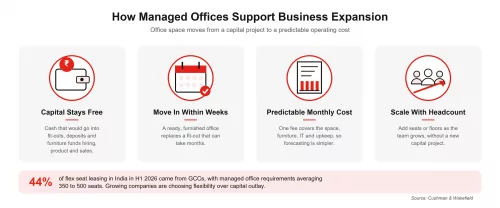
The shift matters most when a company is growing. Cushman & Wakefield reports that GCCs accounted for 44% of flex seat leasing in India in the first half of 2026, with managed office requirements averaging 350 to 500 seats. Those aren’t small teams testing the market. They’re established companies choosing not to tie up capital.
The reasons are practical. Cash that would have gone into ceilings and cabling stays available for hiring, product, and sales. A managed office can be ready in weeks, while a self-built fit-out often takes months. Monthly costs are known in advance, which makes forecasting simpler for the CFO. And when headcount grows, the operator can add seats or floors without a fresh round of approvals for a new capital project.
Awfis’s own research points the same way. According to Awfis, 84% of enterprises now see managed offices as the ideal model for expansion.
There is one caveat worth flagging. Under Ind AS 116, a long agreement for a specific, identified space may need to be recognised on the balance sheet as a right-of-use asset and a lease liability, even when it feels like opex. How a managed office agreement is treated depends on its terms, so finance teams should confirm the accounting with their auditors.
Capital Expenditure Planning for Office Expansion
Good capital expenditure planning starts with honest answers to a few questions. How many people will the business need in one, three, and five years? How confident is that forecast? Which cities matter, and might that change?
If the headcount forecast is stable and the location is fixed, owning or self-building may pay off over a long horizon. Companies taking that route often compare design and build against traditional fit-out to control cost and timelines. Awfis offers this through Awfis Transform.
If growth is uncertain, or the business is entering a new city, a managed office keeps capital free and leaves room to adjust. Many companies blend the two. They keep a long-term headquarters and use managed offices for new teams, project groups or regional hubs.
Whichever route is chosen, read the commitment terms closely. Lock-in periods, exit clauses and expansion rights shape the real flexibility of any office deal, and this guide to lock-in periods in office rental agreements covers what to check.
The Bottom Line
Capex buys ownership, and opex buys flexibility. For a business that is growing quickly, entering new cities or still working out its long-term footprint, flexibility usually wins. Managed offices let companies expand without putting crores into fit-outs, and they turn office space into a cost that moves with the business.
Awfis builds and runs managed offices for enterprises across India, from small project teams to multi-floor offices. Explore Awfis enterprise workspace solutions or talk to the team about a managed office for your next stage of growth.
Frequently Asked Questions
Q1. What is capex?
Capex is spending on long-term assets, such as buildings, fit-outs, furniture and IT. It is capitalised and depreciated over the asset’s useful life.
Q2. What is opex?
Opex is the recurring cost of running a business, such as rent, utilities, maintenance and salaries. It is expensed in the period it is incurred.
Q3. What is the difference between capex and opex?
Capex is a large upfront investment in assets that last more than a year. Opex is a regular running cost. Capex ties up cash early, while opex spreads cost over time.
Q4. Is a managed office capex or opex?
The occupier usually pays a monthly fee, which is generally treated as an operating cost. Under Ind AS 116, some long agreements for identified space may need balance sheet recognition, so confirm the treatment with an auditor.
Q5. Why do expanding companies prefer managed offices?
They avoid large fit-out costs, move in faster, keep costs predictable and can add seats as the team grows.