
Before April 2019, an Indian company could rent a whole office floor for nine years and show nothing on its balance sheet except the monthly rent going out. Then Ind AS 116 arrived. For companies following Ind AS, almost every lease longer than a year now appears as an asset and a liability.
That change made the finance lease vs operating lease question more than an exam topic. It affects reported debt, EBITDA, loan covenants, and how a CFO compares a new office against a managed workspace. This guide explains what each lease is, the difference between an operating lease and a finance lease, how each is accounted for in India, and the types of lease agreements businesses actually sign for office space.
What Is a Finance Lease?
A finance lease transfers substantially all the risks and rewards of owning an asset to the lessee, even though legal title may stay with the lessor. In effect, the lessee is buying the asset on credit.
Accounting standards look for a few signs. A lease is usually a finance lease if:
- Ownership passes to the lessee at the end of the term
- The lessee has an option to buy at a price well below fair value
- The lease runs for most of the asset’s economic life
- The present value of lease payments covers all of the asset’s fair value
- The asset is so specialised that only the lessee can use it without major changes
So what is a finance lease in practice? Think of a factory machine leased for eight of its ten useful years, with a token purchase price at the end. The lessee carries the risk if the machine breaks down or becomes obsolete.
What Is an Operating Lease?
An operating lease is any lease that isn’t a finance lease. The lessor keeps the main risks and rewards of ownership, and the lessee simply pays to use the asset for a period.
Ask most finance teams what is operating lease is in everyday terms, and they’ll point to office rent. A five-year lease on part of an office building is a typical example. The building’s life runs for decades, the landlord keeps it at the end, and its value rises or falls on the landlord’s books, not the tenant’s.
Finance Lease vs Operating Lease: Key Differences
The difference between an operating lease and a finance lease comes down to who effectively owns the asset.
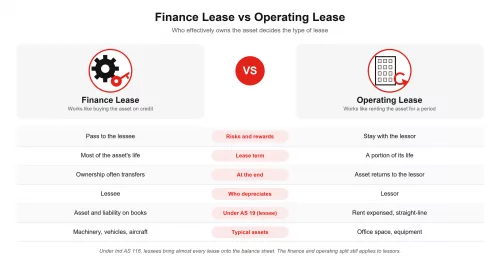
Accounting Treatment of Leases in India
Indian companies follow one of two frameworks. Listed companies and unlisted companies with a net worth of ₹250 crore or more use Ind AS. Most other companies use the older Accounting Standards, where AS 19 governs leases.
Finance Lease Accounting Treatment
Under AS 19, the finance lease accounting treatment for a lessee is to record the asset and a matching liability at the start, at the lower of the asset’s fair value and the present value of the minimum lease payments. Each payment is then split between interest and repayment of the liability, and the asset is depreciated like any other owned asset.
The lessor does the reverse. It removes the asset from its books and records a receivable equal to its net investment in the lease, then recognises finance income over the term.
Operating Lease Accounting Treatment
The operating lease accounting treatment under AS 19 is much simpler for the lessee. Lease payments are charged to the profit and loss account, normally on a straight-line basis over the lease term. Nothing goes on the balance sheet.
The lessor keeps the asset, depreciates it, and records the rent as lease income.
What Changed Under Ind AS 116
Ind AS 116, effective from 1 April 2019, removed the finance and operating split for lessees. A lessee now recognises a right-of-use asset and a lease liability for nearly every lease. Two optional exemptions remain: short-term leases of 12 months or less, and leases of low-value assets such as a laptop.
The profit and loss account changes shape too. Rent disappears and is replaced by depreciation on the right-of-use asset and interest on the liability. Costs are higher in the early years and lower later, and EBITDA goes up because rent is no longer an operating expense.
Lessors were left largely untouched. They still classify each lease as finance or operating and account for it as before.
Types of Leases
Beyond the two main categories, there are several other types of leases businesses come across:
- Sale and leaseback. A company sells an asset it owns, often a building, and leases it back to free up cash.
- Sublease. A tenant leases part of its space to another party.
- Short-term lease. A lease of 12 months or less, which Ind AS 116 lets lessees keep off the balance sheet.
- Leveraged lease. The lessor borrows to buy the asset, common with aircraft and large equipment.
Most types of leases still fall under the finance or operating label for lessors, even when lessees account for them the same way.
Types of Lease Agreements for Office Space
When it comes to offices, the paperwork matters as much as the accounting label. The common types of lease agreements in India are:
- Lease deed. A long-term lease, often 5 to 9 years, with lock-in periods and rent escalation. Leases of immovable property for more than one year must be registered under the Registration Act, 1908, with stamp duty paid.
- Leave and licence agreement. Common in Maharashtra and other states. It gives permission to use the premises without creating a tenancy, and many run for 11 months.
- Coworking or managed office agreement. A service agreement covering a furnished, serviced workspace for a monthly fee.
That last category needs care under Ind AS 116. Whether a managed office agreement counts as a lease depends on its terms, particularly whether the occupier controls a specific, identified space. A contract where the operator can move the client between floors may not be a lease at all. Finance teams should check the treatment with their auditors.
Which Works Better for a Growing Business?
A long lease suits a company that knows its headcount and location for the next decade. It locks in rent, but it also locks in capital for fit-out, deposits, and furniture, plus a lease liability on the balance sheet for Ind AS companies.
A growing business often prefers flexibility. Before committing, it’s worth understanding lock-in periods in office rental agreements and the real difference between leasing and renting office space.
A managed office is the middle path many companies take. The operator funds and runs the fit-out, the occupier pays a predictable monthly fee, and the space can grow with the team. Smaller teams can start with a private cabin on similar terms.
The Bottom Line
The finance lease vs operating lease debate is really a question about ownership and risk. Finance leases behave like borrowing to buy, while operating leases behave like renting. Ind AS 116 has blurred the line for lessees, but the commercial choice between owning, leasing long-term, and staying flexible still shapes a company’s cash and balance sheet.
Awfis works with enterprises across India to set up managed offices that move with their plans, without large upfront capital. Explore Awfis enterprise workspace solutions to see what fits your next stage of growth.
Frequently Asked Questions
Q1. What is a finance lease?
A finance lease transfers substantially all the risks and rewards of ownership to the lessee. It works like buying an asset on credit.
Q2. What is operating lease accounting in India?
Under AS 19, lessees expense operating lease payments, usually on a straight-line basis. Under Ind AS 116, lessees recognise a right-of-use asset and a lease liability instead, except for short-term and low-value leases.
Q3. What is the main difference between a finance lease and an operating lease?
In a finance lease, the lessee effectively owns the asset. In an operating lease, the lessor keeps ownership risks and the lessee pays to use the asset.
Q4. Does Ind AS 116 still separate finance and operating leases?
Only for lessors. Lessees use a single model that brings almost all leases onto the balance sheet.
Q5. Is an office lease a finance lease or an operating lease?
Most office leases are operating leases, because the building’s life is much longer than the lease and ownership stays with the landlord.


